

- A TRS retiree who has at least 30 years of creditable service.
- The retiree must be retired for at least one year before returning to full-time classroom instruction.
- The retiree must be a certified teacher for pre-K through grade 12 whose primary responsibility is academic instruction of students in a classroom.
- TRS requires retirees to teach for a minimum of 50% of the full-time schedule in a qualifying subject area in the classroom.
- Statewide Qualifying Subject Areas: CTAE, Math, Special Education, Science, English Language Arts, Reading, and Writing
- Elementary Educators who teach multi-content areas may qualify for SB 150 if teaching three of the seven statewide qualifying subjects.
- In English Language Arts, Reading, and Writing, educators must currently hold or be enrolled in a program to obtain a current reading or dyslexia certification endorsement approved by the Georgia Professional Standards Commission (GaPSC).
- Literacy Coaches who provide academic instruction in the classroom qualify for SB 150 under English Language Arts, Reading, and Writing subject areas.
- Highest Need Areas
- Local public school systems shall have the ability to hire TRS retirees in areas of the districts’ highest needs as defined by the local school system and the Georgia Department of Education (GaDOE) based on a five-year average of highest needs, and in consultation with the Georgia Professional Standards Commission (GaPSC).
- Highest needs areas are inclusive and not exclusive of the statewide categories. If a system’s highest needs fall in the area of statewide content approval, no additional areas will be approved. If the highest needs areas fall outside of the statewide content areas, then approval may be granted with appropriate documentation.
- No change in a public school system’s area of highest need will require the termination of a TRS Retiree who was hired under HB 385 or SB 150 to fill a highest need area.
- TRS retirees returning to work under SB 150 must meet any applicable GaPSC-approved standards.
- TRS eligibility: confirm the retiree has 30 years of creditable service and at least a one-year break in service.
- GaPSC status: confirm the teacher holds the needed professional certificate and endorsement, if required for the content area.
- Job alignment: confirm the position is a classroom teaching role and the employee’s primary duty is academic instruction in one of the qualifying content areas.
- Retirement timing: confirm the teacher was not restored to service in a way that would disqualify the benefit arrangement under TRS rules.
- The employer must notify TRS of the retiree’s name, compensation, any other remuneration, number of hours, job responsibilities, and any additional information TRS requires within 30 days of hire.
- The employer must pay TRS an amount equal to the applicable employer contribution rate plus employee contribution rate, multiplied by the retiree’s earnable compensation.
- The local system should document that the hire is for a position that fits the statute’s content area and classroom-instruction limits.
- GaPSC’s Retired Educator certificate is for retired educators who may teach or work in educational activities where GaPSC certification is not required, but it cannot be used for positions that require professional certification.
- If the retiree is being hired into a position that requires certification, the retiree must meet the rules for renewing or holding the needed professional certificate; the Retired Educator certificate is not enough by itself.
- TRS does not administer health insurance benefits. State Health Benefit Plan has confirmed that retirees participating under SB 150 will have the same options as those under HB 385. You can find general answers about health insurance coverage options for retirees working under SB 150 at https://shbp.georgia.gov/retirees-0/retirees-who-are-returning-work. You may also contact SHBP at SHBPservicecenter@adp.com or 800-610-1863.
- The Governor signed SB 150 into law with an effective date of 7/01/2026 and the law is scheduled to sunset effective 06/30/2030.
- The employer portal will be available to accept employment verifications for SB 150 beginning Monday, June 15, 2026.
Entry of Electronic Verification Form (EVF)
Employers will complete the employment verification form for SB 150 employment on the TRS website. The employer must report the employment within 30 days of hire.
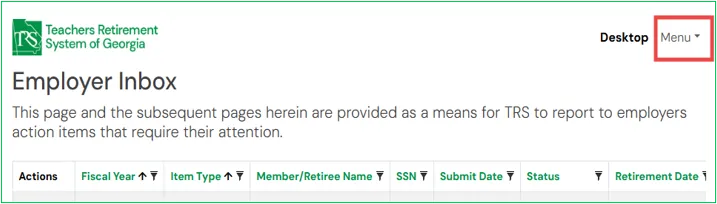
From the Employer Inbox, select the Menu dropdown in the top right of the screen. Select the Employment Verification for a Retiree from the dropdown menu.
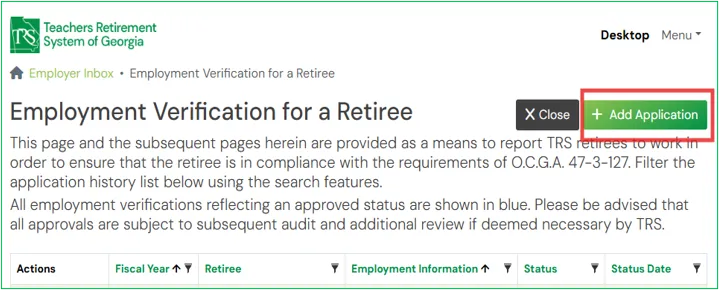
On the Employment Verification page, select the Add Application button to begin submitting an employment verification.
After agreeing with the disclaimer, enter the retiree‘s identifying information and the fiscal year of the employment. A message will display indicating whether or not the retiree has 30 years or more of service. After selecting Next, verify the demographic information and select Next.
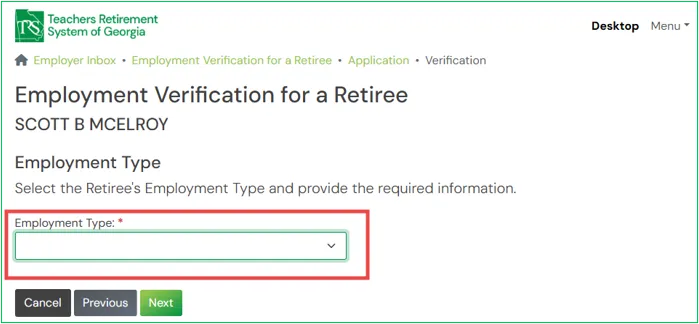
The employer will select the employment type of full-time classroom teacher from the dropdown.
Additional fields will populate. Enter the requested data for each field.
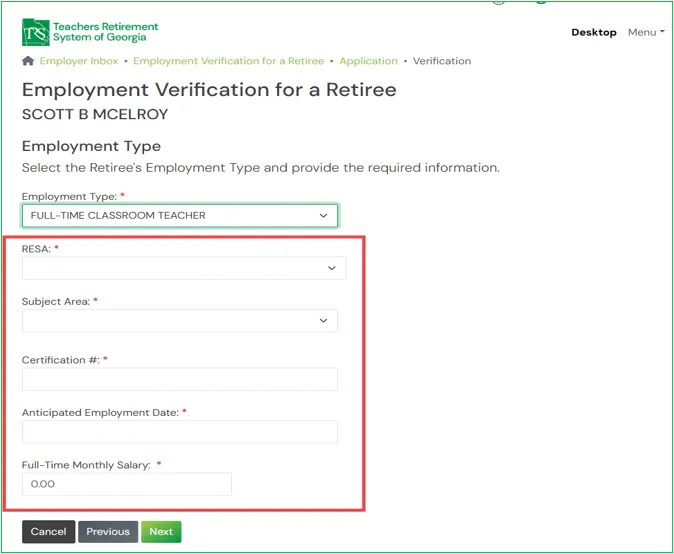
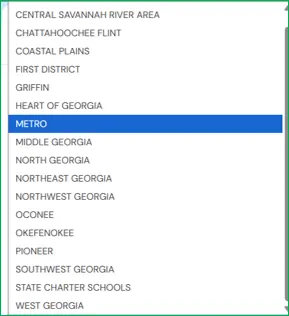
RESA Field
Select the reporting RESA for the employer from the dropdown.
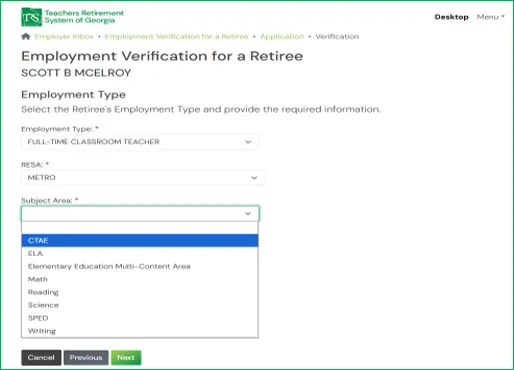
Subject Area Field
Select the critical needs area from the dropdown.
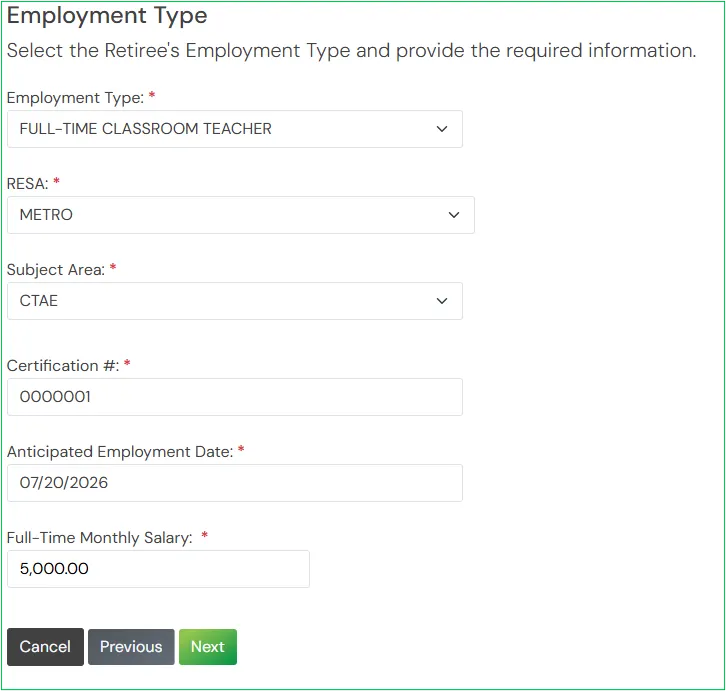
Enter the retiree‘s Certificate Number, Anticipated Employment Date, and the Monthly Salary. Select the Next button.
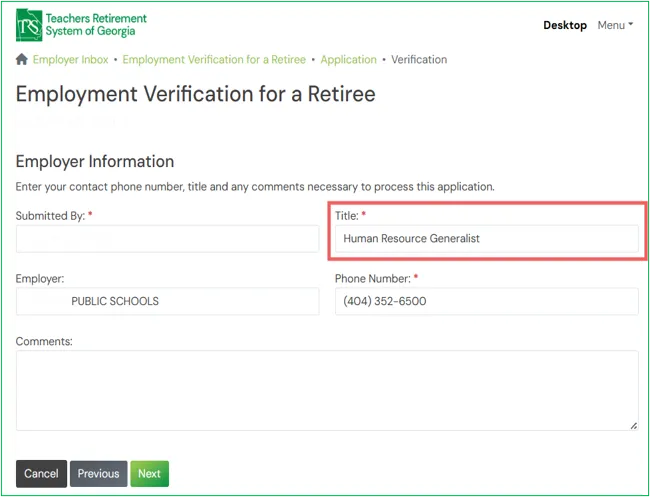
On the Employer Information page, enter your position title and select next.
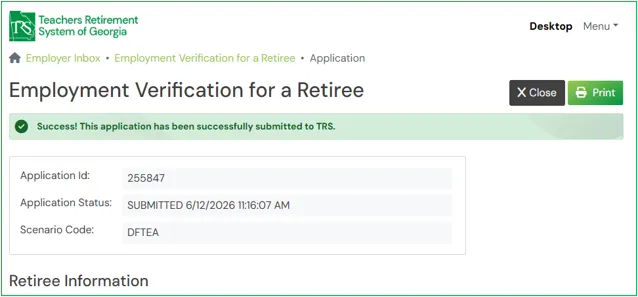
A page will display to verify the inputs. Select Next at the bottom and a final confirmation of the submission will appear. The employer can print a copy for their records.
Reporting SB 150 Contributions
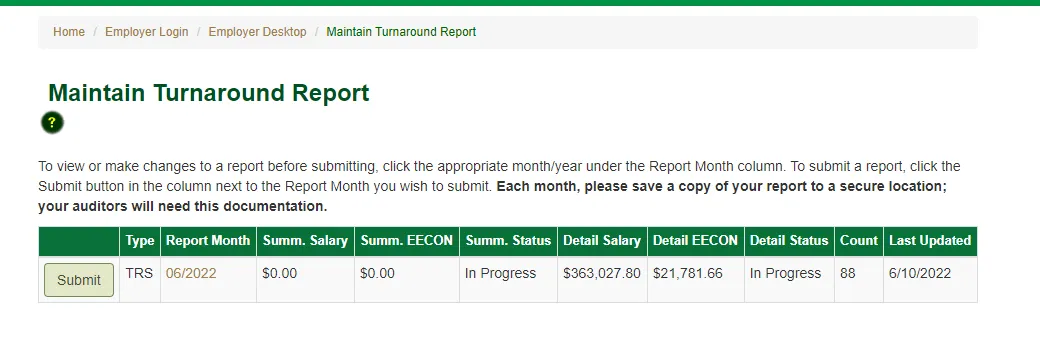
Employers submit contributions to TRS on a monthly basis via a turnaround report or through the upload process, and on the monthly summarization report. Contributions for retirees hired per SB 150 must be reported for every month the retiree is in pay status half or more of the business days. If an employer misses reporting a retiree for a month, retroactive adjustments will be required.
Employers must pay employee and employer contributions; nothing should be withheld from the retiree's compensation. Retirees do not earn service credit for SB 150 employment. After approval of the SB 150 employment by the TRS Retirement Services division, please report contributions for the retiree using these instructions.
TURNAROUND REPORTING
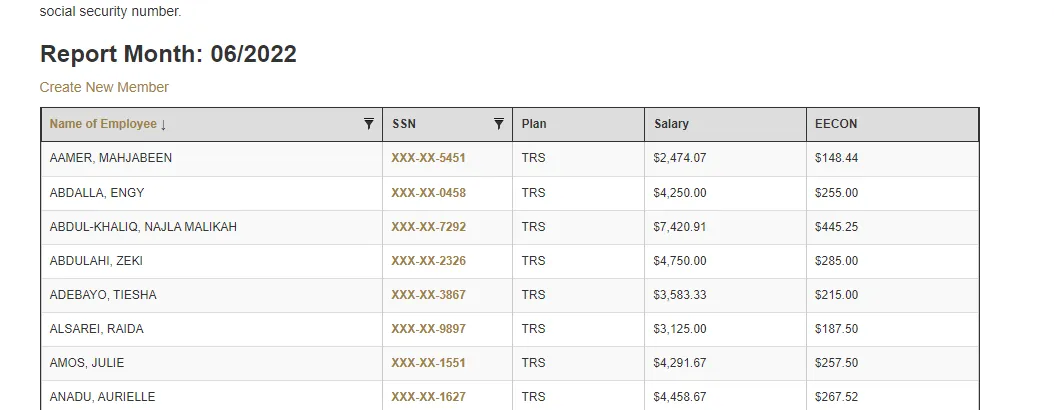
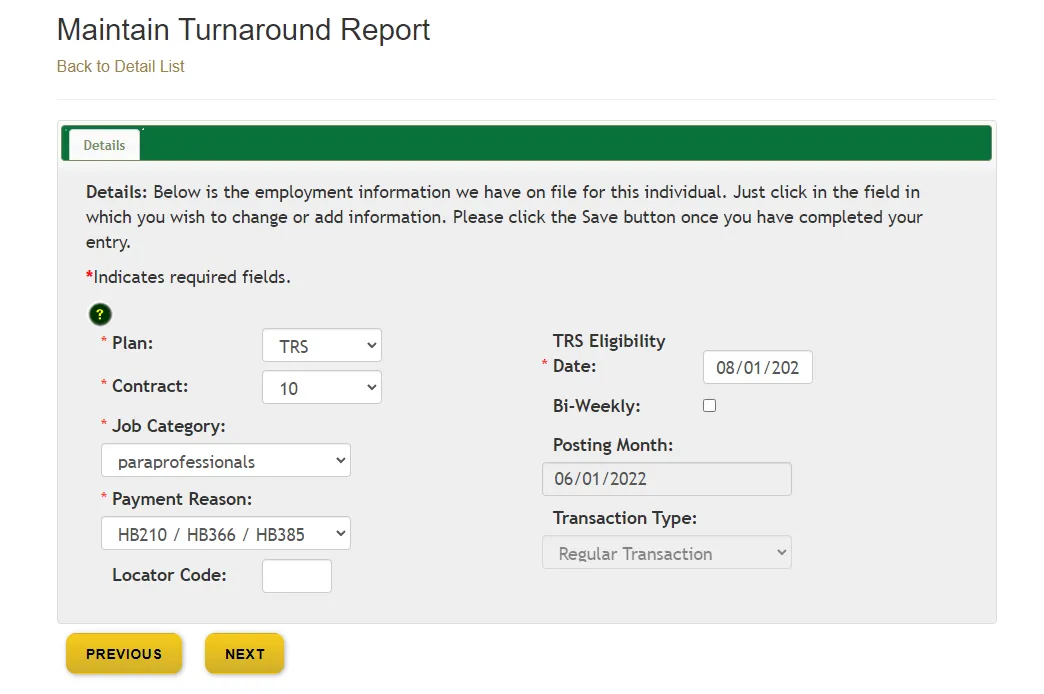
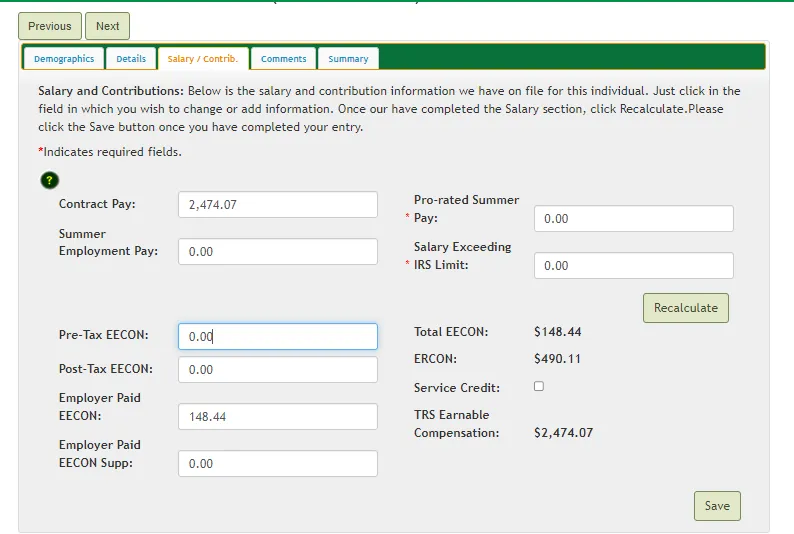
Employers that report through the turnaround process will add the retiree being reported per SB 150, and indicate the Payment Reason code of SB 150 on the turnaround report on the Details tab. The employer will enter the compensation on the Salary/Contributions tab in the Contract Pay field, and contributions in the Employer Paid EECON field. The Service Credit box should not be checked.
FILE UPLOAD REPORTING
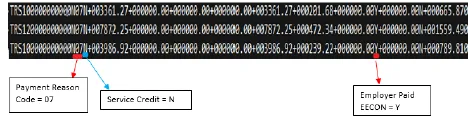
Employers that report through the upload process will indicate the payment reason code for SB 150 as 07. Employers utilize different payroll systems; the employer should reference the employer contribution file layout document on our website. The fields containing employee information (such as SSN, DOB, address, etc.) should be completed as normal. The following fields need to be indicated for each retiree with contributions to be reported per SB 150:
- Indicate positive or negative EECON; negative reporting is needed only when correcting erroneous contributions for a prior month
- Indicate the total EECON
- Indicate positive or negative ERCON; negative reporting is needed only when correcting erroneous contributions for a prior month
- Indicate the total ERCON
- The payment reason code should be 07
- If a payment reason code of 07 is indicated, contributions should be reported in ERCON and EECON
- Employer Paid EECON flag should be set to yes (field 115)
- Do not report service credit for the retiree
Data file example
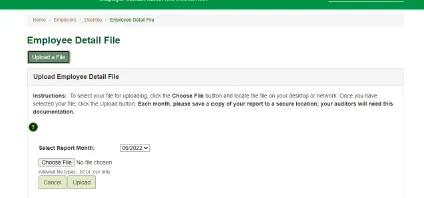
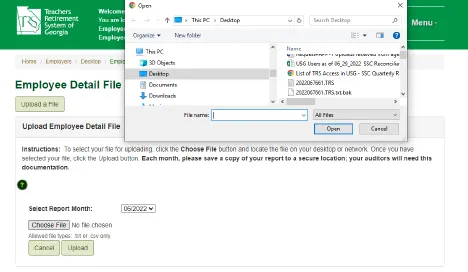
The employer will upload the file as usual.
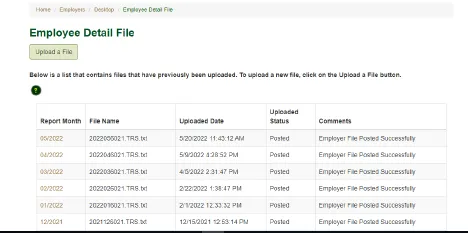
Whether contributions are submitted via turnaround reporting or through the upload process, please ensure the details are as follows:
- Confirm the service credit indicator is no
- Confirm the employer paid EECON indicator is yes
SUMMARIZATION REPORT
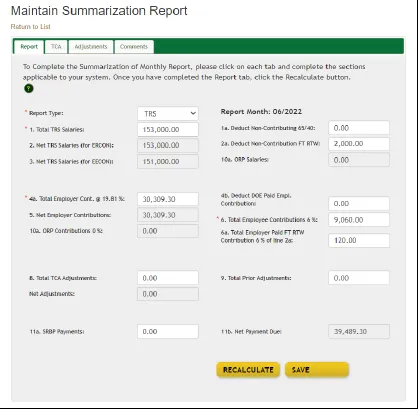
In addition to details submitted via turnaround or file upload, salary and contributions to be reported for retirees employed per SB 150 must be included on the monthly summarization report. Remember that employee (EECON) and employer (ERCON) contributions for retirees hired per SB 150 must be paid by the employer; no contributions should be withheld from the retiree’s compensation. The steps for completing the summarization report are:
- Line 1 - enter total TRS salaries, including retirees employed per SB 150
- Line 2a - enter the total salary for retirees employed per SB 150, then click Recalculate and Save
- Line 6a - enter the total employee contributions for retirees employed per SB 150, then click Recalculate and Save
Fiscal Year 2027 Critical Need Subjects
| District (LEA) | Subject 1 | Subject 2 | Subject 3 |
|---|---|---|---|
| Bacon County | Mathematics | Special Education | English Language Arts/Reading |
| Baconton Community Charter School | Mathematics | Science | English Language Arts/Reading |
| Baldwin County | Mathematics | Special Education | English Language Arts/Reading |
| Barrow County | Mathematics | Special Education | Elementary |
| Bartow County | Special Education | Science | ESOL |
| Ben Hill County | Mathematics | English Language Arts/Reading | Fine Arts |
| Berrien County | Mathematics | Special Education | Science |
| Bibb County | Mathematics | Special Education | Elementary |
| Brantley County | Mathematics | English Language Arts/Reading | Elementary |
| Brooks County | Mathematics | Special Education | English Language Arts/Reading |
| Bryan County | Special Education | Science | Elementary |
| Buford City | Mathematics | Special Education | CTAE |
| Bulloch County | Mathematics | Special Education | Elementary |
| Burke County | Mathematics | Special Education | English Language Arts/Reading |
| Camden County | Mathematics | Special Education | World Languages |
| Candler County | Mathematics | Special Education | Science |
| Carroll County | Mathematics | Special Education | Elementary |
| Carrollton City | Mathematics | Special Education | CTAE |
| Cartersville City | Mathematics | English Language Arts/Reading | World Languages |
| Catoosa County | Mathematics | Special Education | English Language Arts/Reading |
| Charlton County | Mathematics | Special Education | Elementary |
| Chattahoochee County | Special Education | Elementary | ESOL |
| Chattooga County | Special Education | ESOL | World Languages |
| Cherokee County | Mathematics | Special Education | ESOL |
| Cirrus Charter Academy | Mathematics | Science | Elementary |
| City Schools of Decatur | Mathematics | Special Education | World Languages |
| Clarke County | Mathematics | Special Education | Science |
| Cobb County | Mathematics | Special Education | Science |
| Coffee County | Mathematics | Special Education | Science |
| Colquitt County | Mathematics | Special Education | English Language Arts/Reading |
| Columbia County | Mathematics | Special Education | Science |
| Cook County | Mathematics | Special Education | English Language Arts/Reading |
| Coweta Charter Academy | Mathematics | Special Education | ESOL |
| Crawford County | Special Education | Science | Elementary |
| Crisp County | Mathematics | Special Education | English Language Arts/Reading |
| Dade County | Special Education | English Language Arts/Reading | CTAE |
| Dawson County | Mathematics | Special Education | English Language Arts/Reading |
| Decatur County | Special Education | English Language Arts/Reading | Elementary |
| Dodge County | Mathematics | Special Education | English Language Arts/Reading |
| Dooly County | Mathematics | Science | Elementary |
| Echols County | Mathematics | Special Education | English Language Arts/Reading |
| Effingham County | Mathematics | Special Education | Science |
| Elbert County | Mathematics | Special Education | English Language Arts/Reading |
| Emanuel County | Mathematics | Special Education | English Language Arts/Reading |
| Fayette County | Mathematics | Special Education | Science |
| Floyd County | Mathematics | Special Education | English Language Arts/Reading |
| Forsyth County | Special Education | English Language Arts/Reading | Elementary |
| Franklin County | Mathematics | Special Education | Elementary |
| Gainesville City | Special Education | Elementary | ESOL |
| Genesis Innovation Academy for Boys | Mathematics | Special Education | Gifted |
| Genesis Innovation Academy for Girls | Mathematics | Special Education | Gifted |
| Georgia Fugees Academy Charter School | Mathematics | Science | Special Education |
| Georgia School for Innovation and the Classics | Mathematics | Special Education | Elementary |
| Gilmer County | Mathematics | Special Education | English Language Arts/Reading |
| Glynn County | Mathematics | Special Education | Elementary |
| Griffin-Spalding County | Mathematics | Special Education | Science |
| Habersham County | Mathematics | Special Education | Science |
| Hall County | Special Education | Science | Elementary |
| Haralson County | Mathematics | CTAE | JRTOC |
| Harris County | Mathematics | Special Education | English Language Arts/Reading |
| Hart County | Special Education | CTAE | Elementary |
| Heard County | Mathematics | Special Education | English Language Arts/Reading |
| Henry County | Mathematics | Elementary | World Languages |
| Houston County | Mathematics | Special Education | English Language Arts/Reading |
| Irwin County | Special Education | English Language Arts/Reading | Elementary |
| Jackson County | Mathematics | Special Education | English Language Arts/Reading |
| Jeff Davis County | Special Education | English Language Arts/Reading | Elementary |
| Jefferson City | Mathematics | Special Education | Science |
| Lamar County | Mathematics | Special Education | Science |
| Laurens County | Mathematics | Special Education | English Language Arts/Reading |
| Lee County | Mathematics | Special Education | English Language Arts/Reading |
| Liberty County | Mathematics | Special Education | Elementary |
| Long County | Mathematics | Special Education | Elementary |
| Lowndes County | Mathematics | Special Education | English Language Arts/Reading |
| Lumpkin County | ESOL | Gifted | World Languages |
| Macon County | Mathematics | Special Education | Elementary |
| Madison County | Special Education | Elementary | Social Studies |
| Marion County | Special Education | Science | Elementary |
| McDuffie County | Mathematics | Special Education | Science |
| McIntosh County | Mathematics | Special Education | World Languages |
| Meriwether County | Mathematics | Special Education | English Language Arts/Reading |
| Miller County | Mathematics | Science | World Languages |
| Monroe County | Mathematics | Special Education | Science |
| Montgomery County | Special Education | English Language Arts/Reading | Science |
| Morgan County | Mathematics | Special Education | Science |
| Muscogee County | Mathematics | Special Education | Science |
| Oconee County | Mathematics | Special Education | Science |
| Oglethorpe County | Mathematics | Special Education | Science |
| Pataula Charter Academy | Mathematics | Special Education | Elementary |
| Paulding County | Mathematics | Special Education | Science |
| Peach County | Mathematics | English Language Arts/Reading | Elementary |
| Pelham City | Mathematics | Special Education | Science |
| Pierce County | Mathematics | Special Education | Science |
| Polk County | Mathematics | Special Education | CTAE |
| Pulaski County | Mathematics | Special Education | English Language Arts/Reading |
| Putnam County | Mathematics | Special Education | English Language Arts/Reading |
| Quitman County | Special Education | Science | Social Studies |
| Rabun County | Mathematics | Special Education | Science |
| Richmond County | Mathematics | Special Education | Science |
| Rockdale County | Mathematics | Special Education | Science |
| Rome City | Mathematics | Special Education | CTAE |
| Scintilla Charter Academy | Special Education | CTAE | Elementary |
| Screven County | Special Education | English Language Arts/Reading | Science |
| Seminole County | Mathematics | Special Education | Elementary |
| Spring Creek Charter Academy | Special Education | Science | Elementary |
| Statesboro STEAM Academy | Mathematics | English Language Arts/Reading | Elementary |
| Stephens County | Mathematics | Special Education | English Language Arts/Reading |
| Sumter County | Mathematics | English Language Arts/Reading | CTAE |
| Taliaferro County | Special Education | Science | Elementary |
| Tattnall County | Mathematics | Special Education | English Language Arts/Reading |
| Telfair County | Mathematics | Special Education | Science |
| Terrell County | Special Education | English Language Arts/Reading | Elementary |
| Thomas County | Mathematics | Special Education | Science |
| Thomasville City | Mathematics | English Language Arts/Reading | Elementary |
| Tift County | Mathematics | Special Education | Elementary |
| Treutlen County | Mathematics | Special Education | English Language Arts/Reading |
| Troup County | Mathematics | Science | Elementary |
| Twiggs County | Special Education | English Language Arts/Reading | Elementary |
| Union County | Mathematics | Special Education | Elementary |
| Utopian Academy for the Arts Trilith | Mathematics | Special Education | Science |
| Vidalia City | Mathematics | Special Education | Fine Arts |
| Walton County | Mathematics | Special Education | Science |
| Ware County | Mathematics | Special Education | Science |
| Warren County | Mathematics | Special Education | English Language Arts/Reading |
| Wheeler County | Fine Arts | Gifted | World Languages |
| Whitfield County | Mathematics | Special Education | Elementary |
| Wilcox County | Mathematics | Special Education | English Language Arts/Reading |
| Wilkes County | Mathematics | Special Education | Elementary |
| Worth County | Mathematics | Special Education | English Language Arts/Reading |
*Note: The critical needs list reflects employers that reported vacancy data to the GaDOE in June 2026. For employers who are not included on the list, critical needs are limited to the statewide approved subject areas.